Destination guide
Estepona old town
The complete guide to Estepona's historic centre — its flower streets, landmarks, markets and beaches — written from our doorstep on Calle Piña, in the middle of it all.
First steps
Start on the flower streets
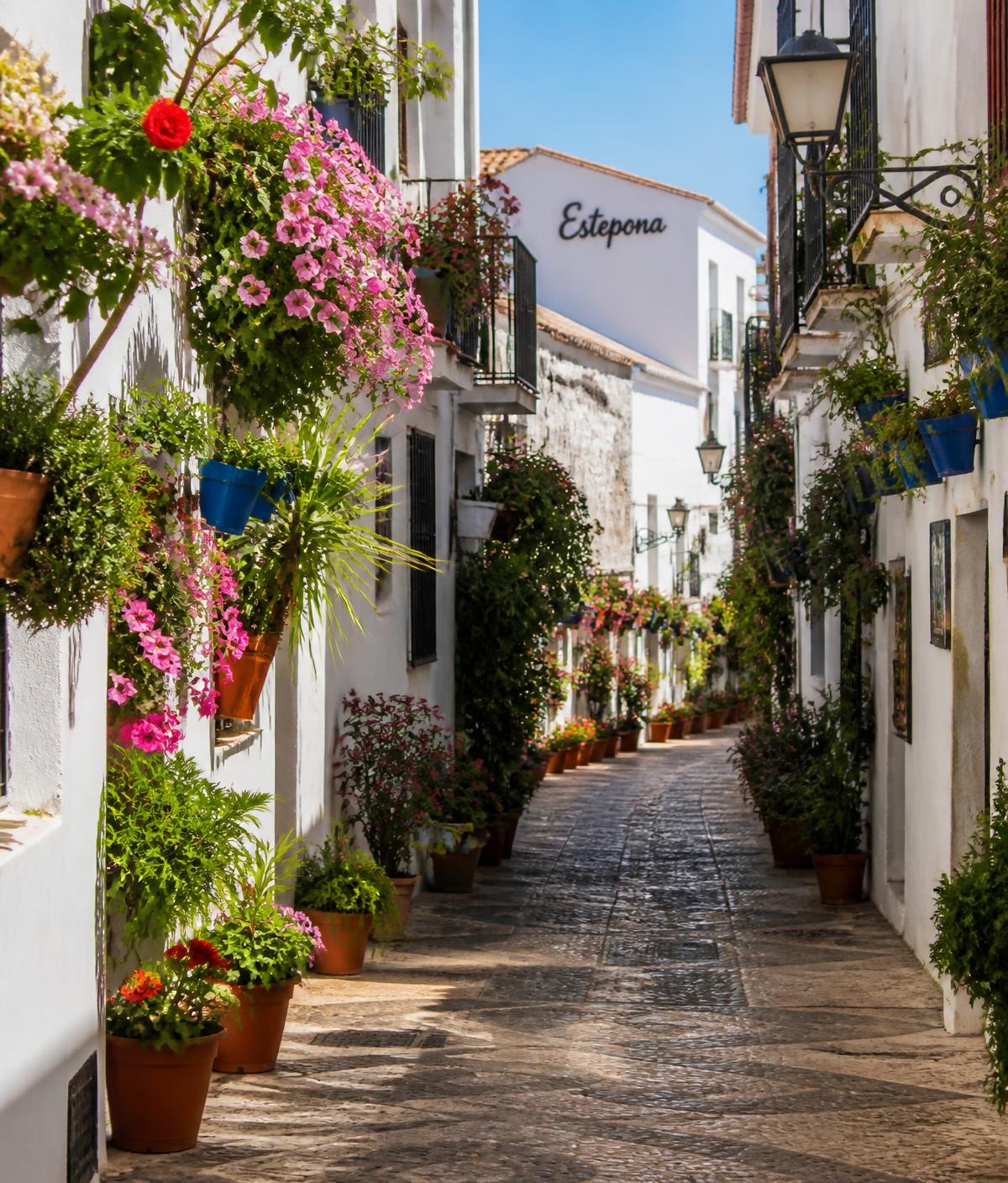
Estepona's old town is small enough to hold in a single morning and rich enough to fill a week of slow walks. The heart of it is a grid of whitewashed lanes where every street has its own colour scheme — pots of geraniums, bougainvillea and jasmine hang from walls that are repainted each spring. From Calle Piña you are inside it in seconds: no car, no plan, just follow the flowers.
Calle Terraza, Calle Caridad and the lanes around Plaza de las Flores are the ones locals photograph most. Go before ten and you will share them mostly with delivery mopeds and cats.
The plaza
Plaza de las Flores — the town's living room
Everything in the old town orbits this small orange-tree square. Coffee in the morning, tapas at noon, families until late — it is where Estepona reads its own newspaper. La Sureña, the family-run tapas bar on the plaza, is where we send every guest first; it is popular with locals for a reason.
From the plaza, Calle Real leads toward the seafront in five minutes on foot. Restaurante Paco on that street is the chiringito the locals use — order the seafood paella.
Landmarks
Castillo de San Luis and the old walls
The recently restored 16th-century Castillo de San Luis stands just above the old town as a reminder that these lanes once sat inside a coastal fortress. It now serves as a museum and exhibition space, and its walls give one of the best orientation points over the rooftops to the sea.
Nearby, the Casa de las Tejerinas in Plaza de las Flores anchors the town's small museum scene, and the Museo Municipal covers archaeology, paleontology and ethnography — an easy, free rainy-morning stop.
An open-air gallery
The Ruta de Murales Artísticos
More than forty large-scale murals are painted across Estepona's facades, turning whole apartment blocks into canvases. The town hall publishes a route map, but the better way is to wander: the works are spread across the old town and the newer barrios, so you collect them as you go.
A loop from Calle Piña through the centre and back along the promenade picks up several of the best-known pieces in about forty minutes, with coffee stops built in.
Green Estepona
The Orchidarium and the parks
The Orchidarium is Estepona's most surprising building: three glass domes housing over 1,300 species of orchid beneath a 17-metre waterfall, a few minutes' walk from the flower streets. It is open year-round and is the town's best bad-weather plan.
Parque de los Niños, closer to the seafront, gives you shaded playgrounds and picnic lawns — the practical answer for families between beach sessions.
The seafront edge
Where the old town meets the beach
The old town ends at Playa de la Rada, Estepona's main beach: 2.5 kilometres of golden sand with a palm-lined promenade and chiringuitos the whole way. Walk west instead and you reach Playa del Cristo — the sheltered cove 150 metres from our door, with calm, shallow water that makes it the family favourite.
That pairing is the old town's real luxury: plaza life in the morning, a proper swim before lunch, and no driving anywhere in between.
Markets
Wednesday and Sunday market days
The Wednesday market along Avenida Juan Carlos I sells everything from fruit and vegetables to shoes and ceramics — arrive early for the produce stalls. On Sundays the market moves to the marina, with more crafts and souvenirs and a lively crowd around the harbour bars.
Both are an easy walk from Calle Piña, and both are where we do our own shopping for guests' welcome baskets.
Practical
Getting around and eating well
You will not need a car inside the old town. Street parking is available near Calle Piña (mind the local restrictions), the nearest bus stop on Avenida Juan Carlos I connects to Marbella and Málaga, and taxis are easy to hail. For groceries, Mercadona on Avenida Juan Carlos I is the big weekly shop; Supercor Express on Avenida España stays open late for everything you forgot.
For dinner beyond the plaza, Taverna Diez on Calle Caridad is the stylish option — creative Mediterranean cooking and a wine list worth the booking.
Questions
Estepona old town FAQ
Is Estepona old town worth visiting?
Yes. It is one of the most carefully kept old towns on the Costa del Sol — pedestrian flower streets, a living local plaza, forty-plus murals, the Orchidarium and two very different beaches within walking distance. Unlike larger resort towns, the centre is still lived in by locals year-round.
How long do you need in Estepona old town?
You can see the highlights in half a day, but the old town rewards slowness. Two or three days lets you walk the mural route properly, eat through Plaza de las Flores and Calle Real, visit the Orchidarium and Castillo de San Luis, and still have beach time at Playa del Cristo and Playa de la Rada.
Where should I stay for Estepona old town?
Inside the old town itself, so the plazas, restaurants and both beaches are on foot. Our apartment on Calle Piña sits in the old town, 150 metres from Playa del Cristo — book direct with us and save 20% on the Booking.com rate.
When is the best time to visit Estepona old town?
Spring and autumn are the sweet spots: warm days, open restaurants and quieter streets. Summer brings the July feria and full beach season. Winter is mild and local — the flower streets and museums stay open and the town feels entirely its own.